
Research-informed assessment
Play-quality evidence your funders and peers will respect.
COPA grounds every score in published research on play affordances, inclusive design, and children's perspectives. Each observation maps to a defined construct, so the evidence you produce is transparent and defensible - not a checklist aggregate.
What COPA measures
Two constructs. Every observation placed within one.
COPA evaluates playspaces through two complementary constructs rooted in the research literature. Play Value (PV) asks what the environment affords for play; Usability (U) asks who can genuinely participate and on what terms.
PV
Play Value
Captures the richness and variety of play opportunities a space provides - across physical, social, sensory, and creative dimensions.
U
Usability
Evaluates whether the space can be accessed and used by a full range of children - including those with different abilities, ages, and backgrounds.
The four scoring lenses
Each construct is scored across four lenses.
Both Play Value and Usability are evaluated through the same four lenses, applied across the whole playspace. This means every score is decomposable - you can see exactly which dimension drove the result.
Provision
What opportunities and resources does the space provide? This lens captures the range and richness of what is on offer.
Variety
How varied are the experiences, materials, and settings available? Variety broadens the range of children who can find something meaningful.
Challenge
Does the space invite risk, mastery, and progression? Challenge is what makes engagement possible at different developmental stages.
Sociability
How well does the space support interaction, cooperation, and belonging? Sociability addresses both physical layout and social affordances.
The whole playspace
10 elements. The environment as a system, not a checklist.
COPA treats the playspace as an integrated environment rather than a list of equipment. Observations are structured across ten elements that together describe the physical, social, and contextual conditions of the site.
- 1Natural features
- 2Manufactured features
- 3Topography & surfaces
- 4Loose parts
- 5Enclosure & open space
- 6Pathways
- 7Seating & amenities
- 8Shade, weather & seasonality
- 9Rules, management & maintenance
- 10Community & site context
The four lenses are applied across all ten elements, for both Play Value and Usability. That structure is what makes cross-site and longitudinal comparisons methodologically sound.
How a score is built
See exactly how observation becomes a number.
The score summary is not a black box. Each percentage is the direct product of structured observations mapped to a defined scoring rubric. You can inspect the data behind any result.
Structured observations, not impressions
Each element is assessed through prompted, defined questions tied to a specific lens. There is no free-form rating - every response has a defined meaning within the framework.
Scores roll up, fully traceable
Lens scores aggregate to construct scores (PV and U). Every number in the summary can be traced back to the individual observations that produced it.
Percentages, not raw tallies
Scores are expressed as percentage of maximum possible within each lens and construct, so they are comparable across playspaces of different scale and type.
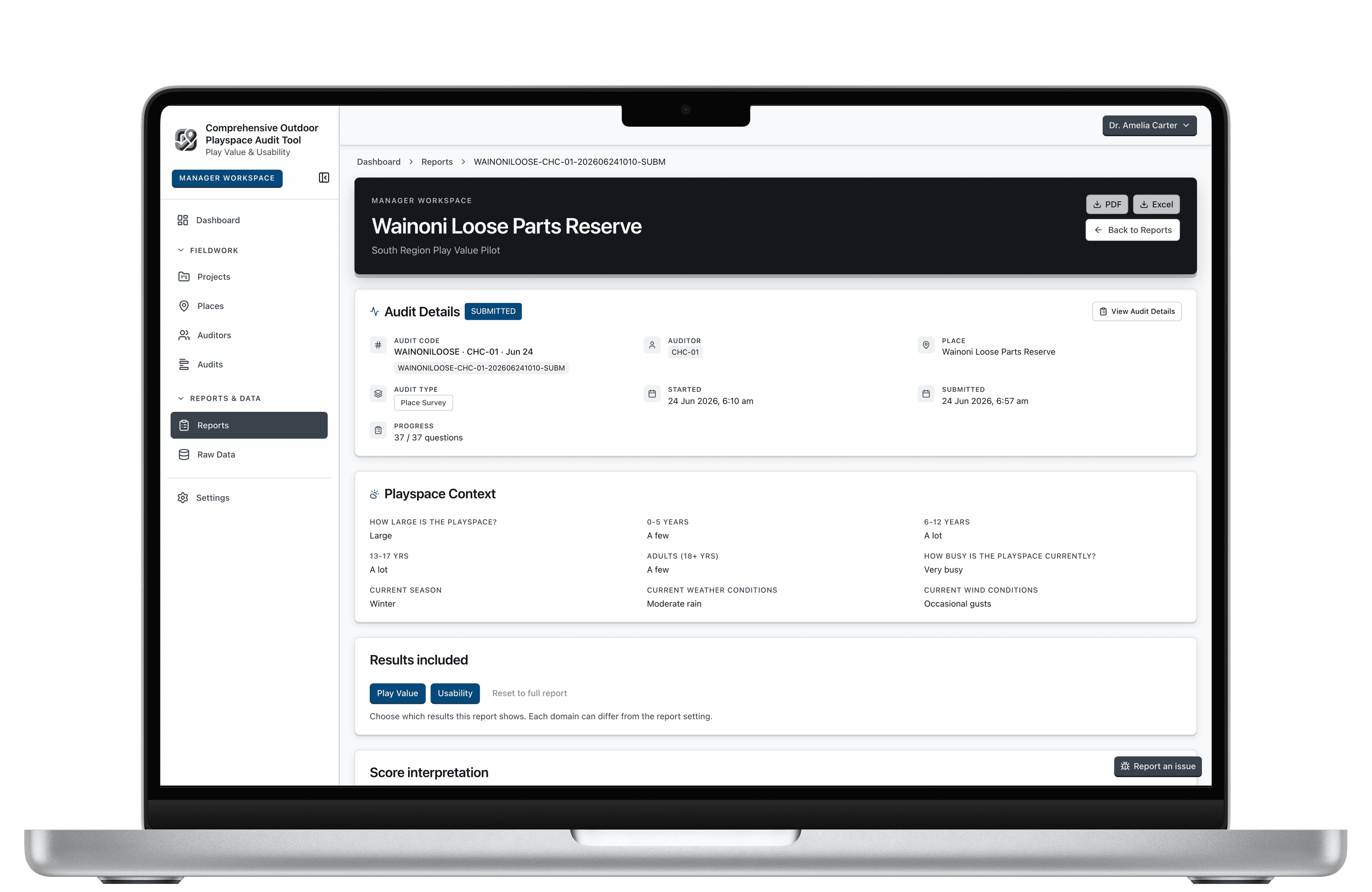
The score summary breaks down Play Value and Usability by lens - Provision, Variety, Challenge, and Sociability - so the source of any result is immediately visible.
The raw observation data is exportable.
Beyond the score summary, the underlying responses for every audit are accessible and exportable as structured data. Researchers can bring COPA output directly into their statistical workflows.
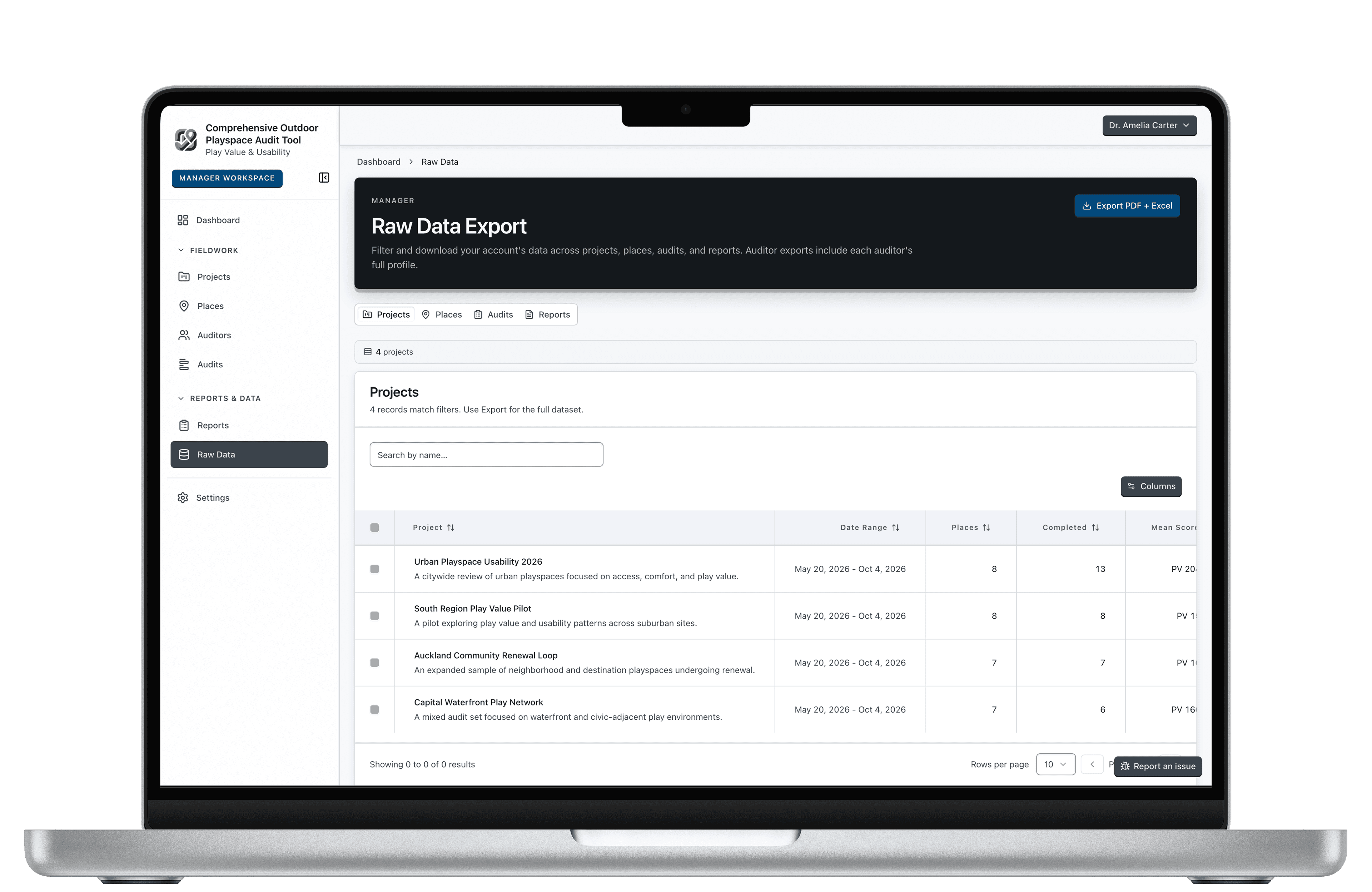
The report detail view exposes every observation behind a score, so reviewers and collaborators can verify the evidence before citing it.
The deliverable
A place report you can cite, share, and act on.
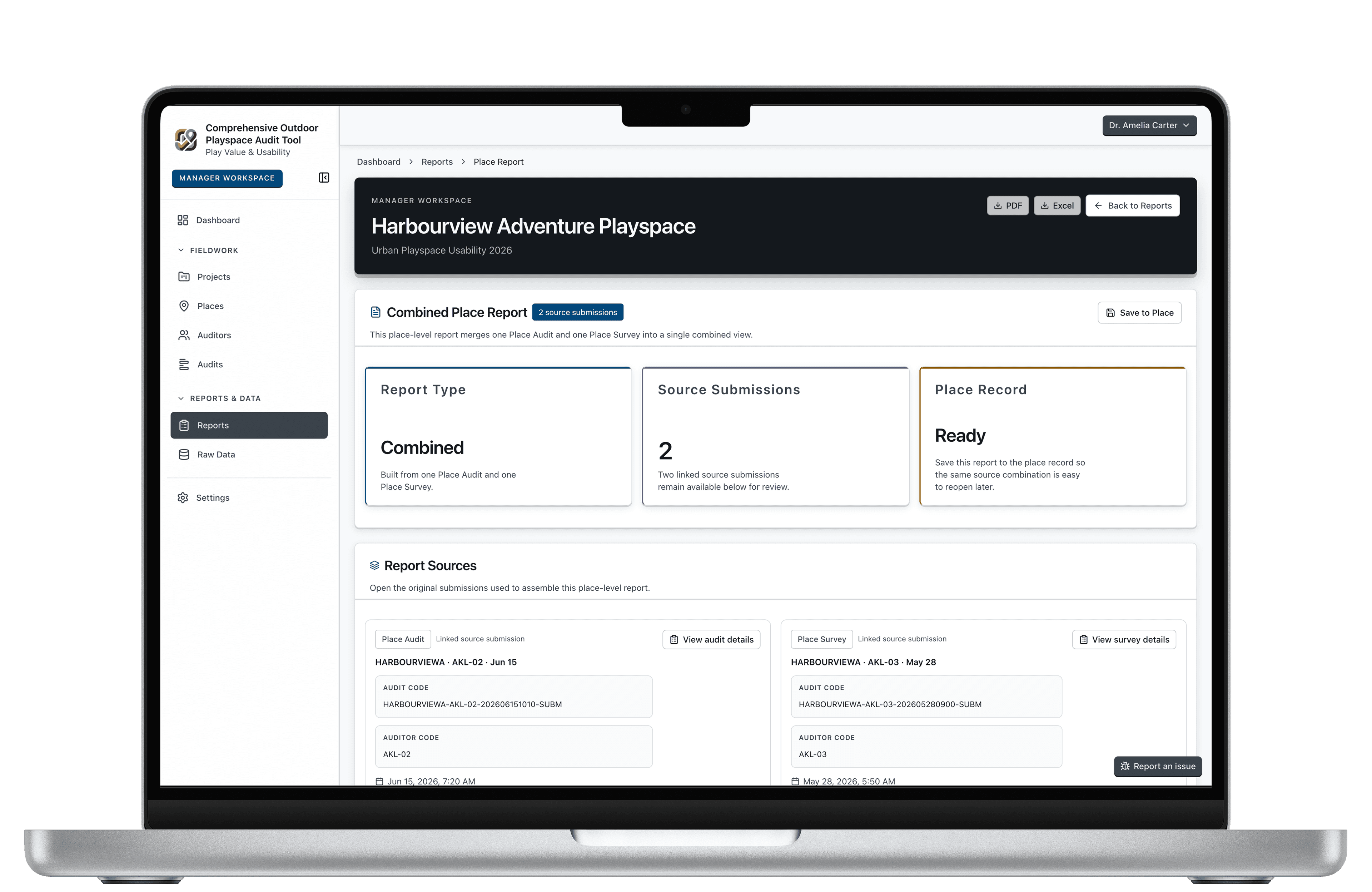
The COPA place report is a structured evidence artefact. It is not a dashboard export reskinned as a document - it is designed from the start to survive a funder review or a peer conversation.
Structured, not narrative
The report is organised around the COPA framework - constructs and lenses - rather than free prose. Reviewers can find any section immediately.
Citable scores with traceable methodology
Each PV and U score includes the lens breakdown that produced it. The methodology is documented in the instrument itself, not separately.
Exportable in the format your workflow requires
Export as PDF for presentations and archiving, Excel for further analysis, CSV for statistical software, or a structured ZIP bundle for research data management.
Multiple audit submissions can be merged
Where the same playspace has been audited more than once, submissions can be combined into a single place report - useful for inter-rater exercises and longitudinal comparison.
Available export formats
The research foundation
Scores grounded in established theory.
COPA is not a practitioner heuristic packaged as an instrument. The constructs and scoring lenses are derived from specific bodies of research that have been applied and tested in playspace and environmental design contexts.
Affordance theory
Scores are grounded in the concept of affordances - what an environment makes possible for a child to perceive and act on - drawing on established research in developmental and environmental psychology.
Inclusive play & usability research
Usability scoring draws on inclusive design frameworks and usability research that foreground children with a range of abilities, ages, and backgrounds.
Children's perspectives
The framework is informed by research that centres children's own accounts of what makes spaces valuable, not only adult proxies for quality.
The people behind the instrument
Expert-designed. Practitioner-tested.
The COPA instrument was developed and reviewed by researchers with specific expertise in children's play environments, inclusive design, and field assessment methods.
Dr. Thomas Morgenthaler
Lead researcher
Developed the COPA framework, constructs, and scoring methodology. Leads the iterative refinement of the instrument through field testing and expert consultation.
Dr. Janet Loebach
Collaborating researcher
Brings expertise in children's outdoor environments and inclusive play design to the instrument review process.
Expert review and iterative field testing.
The instrument has undergone expert review and iterative field testing with practitioners. Formal psychometric validation studies are ongoing. COPA is designed for use by knowledgeable practitioners who bring professional and contextual judgment to the assessment - it is a structured tool in skilled hands, not a fully automated score.
Ready to put rigorous play-quality evidence to work?
Whether you are planning a research pilot, evaluating sites for a grant application, or building an evidence base for a design intervention - COPA gives you a structured, defensible starting point.
COPA is currently delivered through pilots and partner conversations. Contact the team to discuss a research partnership.